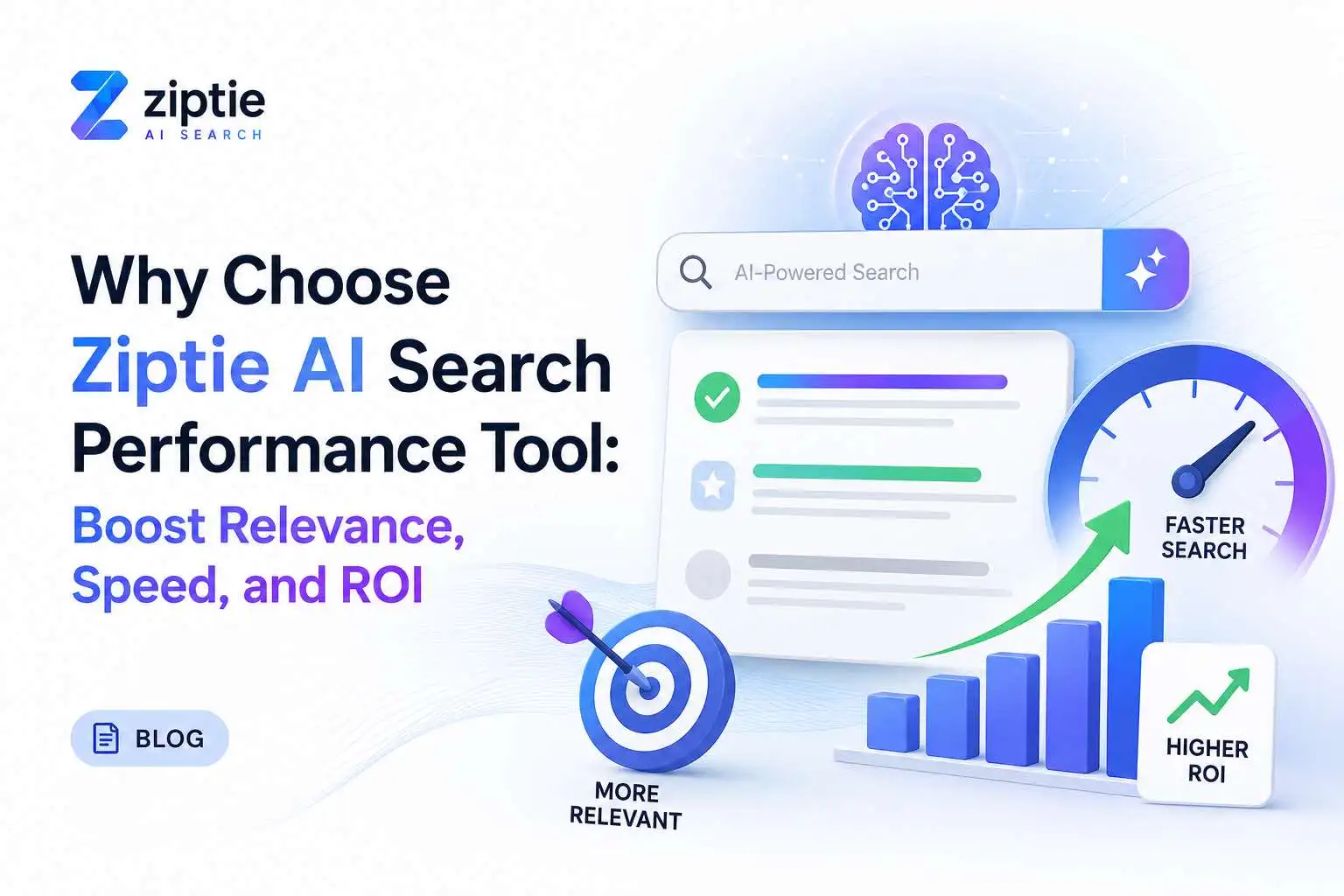
Why Choose Ziptie AI Search Performance Tool: Boost Relevance, Speed, and ROI
You need a tool that shows exactly how your brand appears inside AI-generated answers and gives clear, verifiable metrics you can act on. Ziptie focuses on real AI search performance—tracking visibility across Google AI Overviews, ChatGPT and similar systems—so you get concrete data, not guesses.
Why Choose Ziptie AI Search Performance Tool ,You’ll explore how Ziptie surfaces where your content wins or loses
You’ll explore how Ziptie surfaces where your content wins or loses, how its interface speeds analysis, and how its reports help you prioritize fixes that improve visibility and perception. Expect practical detail on core search capabilities, usability, optimization tactics, integrations, and the analytics that tie effort to outcomes.
Table of Contents
Core Search Capabilities
ZipTie focuses on precise query interpretation, fast updating of indexable content, and delivering topically relevant results that match user intent. You get tools to test complex queries, see live coverage across LLMs, and measure how semantic signals affect visibility.
Advanced Query Handling
ZipTie parses user queries into intent, entity, and constraint layers so you can see exactly why an AI engine chose or ignored your content.
You can run boolean, proximity, and contextual prompts side-by-side and compare which wording surfaces your pages in AI answers. This helps you refine titles, snippets, and schema with evidence rather than guesswork.
The interface exposes token-level matches and highlight maps that show where phrases, synonyms, and citations matched the model’s retrieval step.
You can test long-tail and conversational prompts to simulate real user sessions and measure rank stability across phrasing variations.
Key features you’ll use:
- Query decomposition view (intent/entity/constraint)
- A/B prompt testing for phrasing impact
- Token-match heatmaps and citation tracing
Real-Time Indexing
ZipTie ingests new and updated content continuously so you can detect presence or absence in AI answers within minutes.
You monitor crawl-to-visibility latency and get alerts when fresh pages begin appearing — or drop out — of model responses.
You can map ingestion timestamps against model snapshot dates, which shows whether a visibility gap stems from your publishing pipeline or the model’s knowledge cutoff.
The tool supports push hooks and sitemap monitoring to reduce time-to-index for priority pages.
Operational controls include:
- Live ingestion dashboard with latency metrics
- Push API and sitemap/watchlist integration
- Alerting on first-appearance and visibility loss events
Semantic Relevance
ZipTie scores semantic alignment between your content and query intents using vector-based embeddings and topical graphs.
You’ll see a relevance score, nearest neighbor examples that helped the model, and recommended content signals to boost alignment.
The platform explains which sections, headings, or data points contributed most to relevance, enabling targeted edits instead of site-wide rewrites.
You can prioritize updates by estimated visibility impact and track how small semantic tweaks change appearance probability across different LLMs.
Outputs you’ll act on:
- Embedding-similarity score and contributing passages
- Topical graph showing gaps versus top-performing answers
- Ranked recommendations for microcontent edits
User Experience and Interface
Ziptie groups the controls you use most into clear, configurable panels and keeps navigation one click away. You’ll find metrics, alerting, and export controls surfaced where you need them, with minimal visual clutter.
Customizable Dashboards
You can build multiple dashboards tailored to specific goals — brand visibility, source breakdowns, or answer-level performance. Drag-and-drop widgets let you place charts, top-answer lists, and alert feeds exactly where you want them.
Widgets include real-time share-of-voice, historical trend charts, and a table view that links each answer to its originating source and timestamp. You can resize or pin widgets, save dashboard versions, and set a default dashboard per team role.
Dashboard settings let you apply filters globally: date ranges, search channel (ChatGPT, Perplexity, Google AI Overviews), and audience segment. Exports support CSV and PNG, and scheduled snapshots can be emailed to stakeholders automatically.
Intuitive Navigation
Primary navigation uses a left-hand rail with clearly labeled sections: Dashboards, Monitoring, Alerts, Reports, and Settings. Each section reveals context-specific actions in an action bar, so you take common tasks — run a query, create an alert, export results — in one click.
Search and quick-access keyboard shortcuts speed up workflows. Use the global search to jump to any page, open saved queries, or locate a specific answer by URL. Breadcrumbs and in-line tooltips reduce learning time for new users.
Tables and lists are interactive: click a row to open the answer detail pane, then navigate to the source or add a note without leaving the page. This keeps analysis focused and reduces back-and-forth between screens.
Accessibility Features
Ziptie follows accessibility best practices to ensure screen-reader compatibility and keyboard navigation across the app. Aria labels and logical heading structures let you navigate dashboards and result lists without relying on a mouse.
Color choices maintain contrast ratios for readability, and you can switch to a high-contrast theme. Text size adjusts UI elements responsively, and charts provide alternative data tables for users who prefer or require non-visual formats.
Notifications and alerts support multiple channels: in-app banners, email, and webhook delivery. You can tune alert severity and delivery rules so critical items reach you through accessible, reliable paths.
Performance Optimization
ZipTie focuses on fast, reliable monitoring and efficient processing so you can see AI visibility metrics with minimal delay and handle larger datasets without manual tuning.
Low Latency Responses
You get near-real-time updates by prioritizing lightweight probes and caching only verified citation mappings. This reduces average query-to-update time, so you act on visibility shifts within hours rather than days.
The system uses incremental polling for high-priority queries and batch checks for lower-priority ones. That hybrid approach lowers API calls and avoids throttling from data sources while keeping the freshest results for your most important keywords.
ZipTie also applies edge caching and compact result payloads to cut network overhead. Those design choices shorten response times for dashboard loads and API retrievals, giving you faster reports and alerts when placement or citations change.
Scalability for Growing Data Sets
ZipTie scales horizontally using sharded collectors and a metadata-first index to keep performance predictable as query volume grows. You can add more monitored queries without linear increases in processing time because work distributes across workers and shards automatically.
Retention policies and tiered storage let you keep recent, high-resolution data accessible and older records compressed. That reduces storage costs while preserving the ability to run historical trend analyses.
For integrations, ZipTie exposes bulk ingest and export endpoints with rate controls. You can feed large keyword lists or pull months of citation data without manual batching, which helps when you expand monitoring across brands, regions, or language variants.
Integration and Compatibility
Ziptie AI connects with the systems you already run and adapts to common deployment patterns. It supports both cloud-native and on-prem workflows and offers tooling that fits into CI/CD, observability, and search stacks without heavy rework.
Multi-Platform Support
Ziptie runs natively on Linux distributions (Ubuntu, RHEL/CentOS, Debian) and in containerized environments via Docker and Kubernetes. You can deploy as a single binary for lightweight edge nodes or as a scalable microservice cluster behind an ingress controller.
The agent footprint is small: most installations use under 200 MB and require 1–2 vCPUs per replica in production. Resource limits and horizontal autoscaling rules are supported out of the box.
It integrates with major cloud providers (AWS, GCP, Azure) using provider-specific IAM roles and managed services for storage and metrics. You can route logs and traces to systems like Prometheus, Grafana, and ELK with prebuilt exporters and configuration templates.
Supported OS, runtimes, and orchestration:
- Linux: Ubuntu 20.04+, RHEL 8+, Debian 10+
- Containers: Docker images, Helm charts, Kubernetes Operator
- Cloud: IAM-based auth for S3/GCS/Azure Blob, load balancer annotations
API and Plugin Ecosystem
Ziptie exposes a RESTful API for search indexing, query submission, and performance telemetry. The API uses JSON over HTTPS, supports API keys and OAuth2 client credentials, and documents endpoints with OpenAPI for straightforward client generation. Rate limits and ACLs are configurable per API key.
A plugin SDK (Python, Go, Node.js) lets you write custom data connectors, query transformers, and result enrichers. Plugins run in isolated sandboxes or as external microservices and register via the control-plane API. Official plugins include connectors for PostgreSQL, MySQL, Redis, S3, and BigQuery.
Key integration features:
- OpenAPI spec and client libraries in major languages
- Webhooks and event streams for index lifecycle events
- Plugin marketplace and versioned plugin registry
You can test integrations locally with included mock servers and CI scripts. The SDK includes templates and unit-test helpers to keep your customizations maintainable and auditable.
Analytics and Reporting
ZipTie gives you precise visibility into where your content appears, how often it’s used in AI answers, and which queries drive that exposure. You’ll see metric breakdowns by model, source (Google AI, ChatGPT, Perplexity, etc.), geography, and time window so you can act on concrete signals.
Detailed Usage Metrics
ZipTie reports include impressions, answer share, and estimated traffic lift for each tracked query and page.
You can filter by LLM (e.g., ChatGPT vs. Google AI Overviews), by country, and by SERP position to attribute visibility to specific formats and regions.
The dashboard shows time-series charts for trends and a table of top-performing prompts and pages.
Exportable CSVs and scheduled PDF reports let you integrate metrics into existing reporting workflows.
You’ll also get side-by-side comparisons of your brand versus competitors on identical queries, with percentage differences for quick prioritization.
Insights for Continuous Improvement
ZipTie translates raw metrics into actionable recommendations, prioritized by potential impact and effort.
Examples include which pages to expand, which schema types to add, and which high-value queries need better source signals.
The platform surfaces phrasing and structural cues from AI-overview snippets that correlate with higher answer share.
You can run A/B style content experiments, track lift over weeks, and receive alerts when visibility drops for high-value queries.
These insights tie directly to execution: suggested copy changes, metadata edits, and backlink targets appear alongside estimated impact so you decide where to invest your time.