

How to Build Passive Income with Real Estate in 2026: A Complete Guide
Imagine waking up to steady monthly cash flow generated by high-performing property assets—without spending your weekends dealing with tenant complaints or repairing leaky pipes. In 2026, real estate investing is no longer reserved for institutional funds or hands-on landlords willing to manage physical properties around the clock. Thanks to digital platform innovations, advanced prop-tech tools, and modern investment vehicles, building hands-off wealth through real estate is more accessible than ever before.
Yet, many prospective investors remain trapped on the sidelines. Rising living costs and traditional stock market volatility make true financial security feel out of reach, while navigating today’s unique real estate market—marked by shifting interest rate cycles and evolving tax codes—can leave even seasoned investors feeling overwhelmed.
If you are looking for a clear, actionable roadmap on how to build passive income with real estate in 2026, you have come to the right place. The fundamental power of real property to deliver consistent rental yield, tax benefits, and long-term equity appreciation remains unmatched, but the strategies to unlock these benefits have evolved dramatically.
In this complete guide, we demystify modern passive real estate investing. From low-barrier options like REITs and fractional crowdfunding to high-yield syndications and fully managed turnkey properties, you will learn how to select, fund, and scale passive real estate assets aligned with your financial goals. Let’s dive into the blueprint that puts your capital to work so you don’t have to.
Table of Contents
Understanding Real Estate Passive Income Strategies in 2026
The real estate market of 2026 operates on a different set of rules than it did just a few years ago. Higher baseline interest rates, institutional dominance in traditional markets, and rapid advancements in property technology (PropTech) have reshaped how cash flow is generated. Learning how to build passive income with real estate in 2026 requires moving past outdated advice like “just buy a local duplex and collect rent.” Today’s successful investors rely on a sophisticated array of vehicle choices tailored to their specific risk tolerance, capital availability, and desire for true hands-off income.
Before committing capital, it is essential to understand that passivity in real estate exists on a spectrum. No property investment is 100% passive by nature; rather, passivity is achieved either through financial securitization (investing in funds) or by leveraging third-party management systems to handle daily operations.
The Real Estate Passivity Spectrum: Direct vs. Indirect Ownership
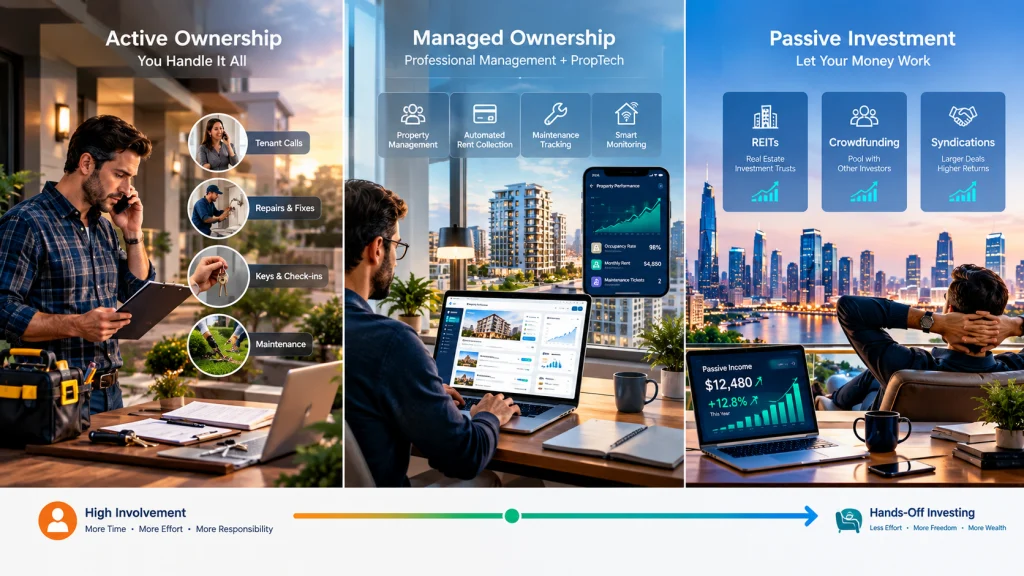
To choose the right path, you must evaluate the trade-off between control and time involvement. Real estate passive income strategies generally fall into two categories:
- Indirect Ownership (Hands-Off Capital Allocation): You invest money into a company, fund, or platform that buys and manages real estate on your behalf. You act purely as a silent financial partner. This approach offers the highest level of passivity, maximum diversification, and zero landlord responsibilities, though you trade away operational control.
- Direct Ownership with Professional Delegation (Systems-Based Passivity): You own the deed to physical property, but you hire property management firms and utilize modern PropTech tools to automate tenant screening, rent collection, and maintenance routing. You remain the ultimate decision-maker while remaining free from daily management.
Core Passive Income Vehicles for Modern Investors
Whether you have $500 or $500,000 to invest, there is a distinct pathway to earning passive rental income in 2026. Here are the primary strategies currently yielding strong results for passive investors:
1. Real Estate Investment Trusts (REITs)
REITs remain the most accessible gateway to real estate passive income. By law, publicly traded REITs must pay out at least 90% of their taxable income to shareholders in the form of dividends. In 2026, specialized REITs focusing on data centers, modern logistics hubs, and senior housing continue to outperform traditional office and retail sectors. They offer stock-like liquidity, requiring no asset management, though dividends are generally taxed as ordinary income.
2. Real Estate Crowdfunding and Tokenized Fractional Ownership
Crowdfunding platforms have matured significantly, giving everyday investors fractional access to commercial assets, industrial parks, and multi-family developments. Powered by automated smart contracts and digitized security tokens, modern fractional platforms allow you to buy equity shares in specific high-yield properties with minimal capital commitments—often starting between $100 and $5,000.
3. Real Estate Syndications (Limited Partnerships)
For accredited investors with higher capital reserves, private syndications offer unmatched tax efficiency and passive scale. In a syndication structure, a professional operator (the General Partner) sources, acquires, and manages a large asset—such as a 200-unit apartment complex. As a passive investor (the Limited Partner), you receive preferred returns and equity upside upon sale without taking on operational liabilities.
4. Turnkey Rental Properties
Turnkey real estate involves purchasing fully renovated single-family homes or small multi-family units in high-cash-flow markets, pre-staffed with property management and reliable tenants. Turnkey companies handle the acquisition and rehabilitation, allowing you to buy fully operational, income-generating residential real estate remotely from day one.
5. Tech-Enabled Remote Direct Ownership
Advances in AI-driven market analytics, virtual property tours, and centralized property management software have made out-of-state direct real estate investing truly practical. Investors can live in high-cost metro areas (like San Francisco or New York) while buying cash-flowing rental units in growing Sunbelt or Midwestern markets, managing the asset managers via digital dashboards.
Comparing Strategy Fit: Passivity, Capital, and Return Potential
To help you determine which strategy aligns best with your current financial position, the table below compares the core passive real estate strategies of 2026 across key criteria:
| Strategy | Passivity Level | Minimum Capital Needed | Target Return Profile | Key Investor Advantage |
|---|---|---|---|---|
| Public REITs | Ultra-High (100% Passive) | Very Low ($10 – $100) | Moderate (Dividends + Liquidity) | Instant liquidity and total diversification. |
| Crowdfunding / Fractional | High (Hands-off) | Low to Moderate ($100 – $5,000) | Moderate to High | Targeted property selection with low capital barriers. |
| Real Estate Syndications | High (Limited Partner role) | High ($25,000 – $100,000+) | High (Cash flow + Tax depreciation) | Significant tax shields (bonus depreciation) & strong equity upside. |
| Turnkey Properties | Moderate to High | Moderate to High ($20,000 – $50,000 down) | Moderate to High (Cash Flow + Equity) | Direct property ownership without renovation hassles. |
| Managed Remote Property | Moderate (Requires oversight) | Moderate to High ($25,000+ down) | High (Maximum leverage & cash flow control) | Complete asset control and maximum tax write-offs. |
Choosing the right strategy depends entirely on your personal resources: if you are short on time but rich in capital, syndications or turnkey properties offer high leverage; if you are starting with smaller capital reserves, REITs and crowdfunding platforms provide an ideal launchpad to compound wealth passively.
Investing in REITs and Real Estate Crowdfunding
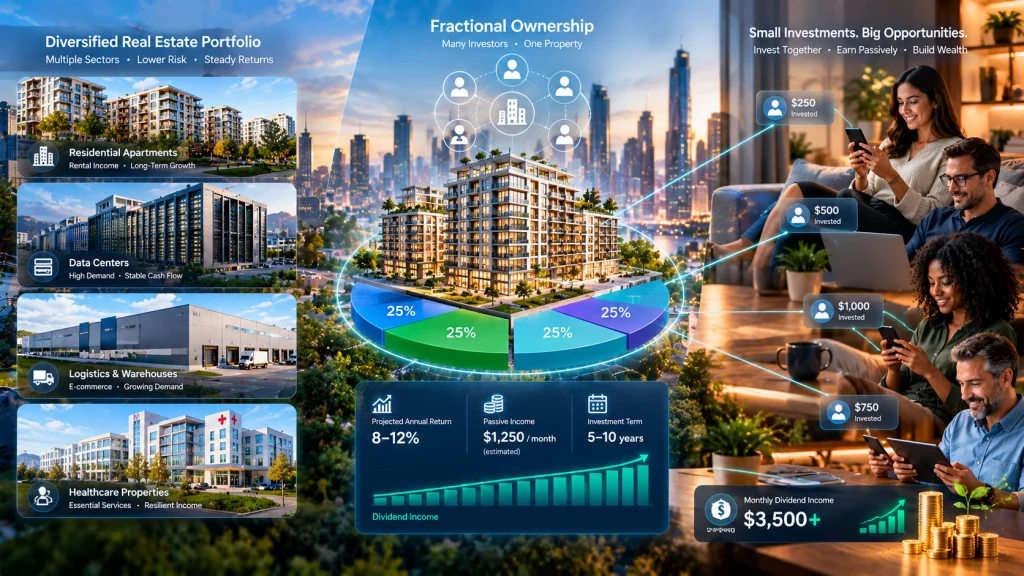
For investors seeking true hands-off income, traditional property acquisition—with its requirement for down payments, tenant management, and physical maintenance—is often a non-starter. Fortunately, financial innovation has democratized real estate investing. In 2026, building passive income with real estate no longer mandates owning an entire building. By utilizing Real Estate Investment Trusts (REITs) and real estate crowdfunding platforms, you can generate reliable cash flow through fractional ownership and high-yield real estate debt.
Both avenues allow you to participate in institutional-grade commercial and residential markets with significantly lower capital requirements, providing an ideal entry point for beginners and a powerful diversification tool for seasoned investors.
1. Real Estate Investment Trusts (REITs): Liquid Dividend Engines
A Real Estate Investment Trust (REIT) is a company that owns, operates, or finances income-producing real estate. Modeled after mutual funds, REITs allow individual investors to earn dividends from real estate investments without having to buy, manage, or finance any properties directly.
To qualify as a REIT under federal tax law, an entity must distribute at least 90% of its taxable income to shareholders annually in the form of dividends. Because REITs pay no corporate income tax at the entity level if they comply with this rule, a larger portion of operational income flows directly to investors.
Key REIT Categories to Consider in 2026:
- Equity REITs: These entities buy, manage, and develop income-producing real estate properties (such as industrial warehouses, data centers, apartment complexes, and medical office buildings). Income is derived primarily from tenant rent and property appreciation.
- Mortgage REITs (mREITs): Instead of owning physical real estate, mREITs purchase or originate mortgages and mortgage-backed securities (MBS). They generate income from the interest spread between borrowing costs and earnings on mortgage assets. While offering higher yields, they carry elevated interest rate sensitivity.
- Publicly Traded vs. Non-Traded REITs: Publicly traded REITs list on major stock exchanges (like the NYSE or NASDAQ), offering daily market liquidity and instant execution. Non-traded REITs are registered with regulatory bodies but do not trade on public exchanges, offering lower price volatility in exchange for reduced liquidity and potential lock-up periods.
2026 REIT Strategy Insight: Focus on sector-tailored Equity REITs aligned with long-term macroeconomic trends, such as data centers powering AI infrastructure, modern logistics hubs supporting automated supply chains, and specialized healthcare facilities serving an aging demographic.
2. Real Estate Crowdfunding: High-Yield Fractional Ownership
Real estate crowdfunding leverages online platforms to pool capital from hundreds or thousands of individual investors to fund specific private real estate deals or curated portfolios. Unlike public REITs, which trade based on broader stock market sentiment, crowdfunding platforms connect investors directly to private market transactions managed by professional real estate sponsors.
Crowdfunding bridges the gap between public markets and private equity real estate, allowing everyday investors to participate in deals traditionally reserved for high-net-worth individuals and institutional funds.
Investment Structures: Debt vs. Equity Crowdfunding
- Debt Crowdfunding: You act as the lender to a real estate developer or builder. Your investment is secured by the underlying property (usually as a first-lien position). In return, you receive fixed interest payments, typically paid quarterly or monthly. This structure offers lower risk, predictable return profiles, and shorter investment horizons (typically 12 to 36 months).
- Equity Crowdfunding: You purchase an equity stake in a specific property or commercial deal. Income comes from your pro-rata share of ongoing rental cash flow, plus a share of the capital gains upon property sale. Equity deals offer higher upside potential through appreciation and depreciation tax benefits, but carry longer holding periods (typically 3 to 7 years).
Platform Evolution in 2026: Modern crowdfunding platforms have lowered minimum investment barriers—ranging from as low as $100 for automated fund products to $5,000–$10,000 for direct deal syndications. Enhanced secondary markets on select platforms have also improved liquidity options for private deals.
Comparing REITs vs. Real Estate Crowdfunding
While both vehicles provide fractional exposure to real estate, their structural differences impact liquidity, risk, tax efficiency, and capital requirements. The table below outlines how these two passive investment strategies stack up:
| Feature | Publicly Traded REITs | Real Estate Crowdfunding |
|---|---|---|
| Liquidity | High: Buy/sell instantly during market hours on public stock exchanges. | Low to Moderate: Capital locked for 1 to 7 years depending on deal structure. |
| Minimum Investment | Very Low: Cost of a single share (often under $50). | Low to Moderate: $100 to $10,000 depending on platform and deal tier. |
| Price Volatility | Moderate to High: Subject to daily stock market sentiment and macro fluctuations. | Low: Valuations are tied to asset performance, not public market swings. |
| Tax Advantages | Standard Income: Dividends typically taxed as ordinary income (qualified 199A deduction may apply). | Direct Tax Benefits: Equity deals often pass through depreciation (K-1 tax filing) to offset gains. |
| Control & Transparency | Institutional Management: High regulatory oversight, but limited direct deal choice. | Deal-Level Selection: Ability to underwrite individual properties and asset sponsors. |
Constructing a Balanced Passive Portfolio in 2026
To maximize yields while controlling risk, modern passive income investors should not view REITs and real estate crowdfunding as mutually exclusive. Instead, combining both strategies creates a resilient real estate allocation tailored for dynamic economic conditions.
Follow these actionable steps to build a balanced, hands-free income engine:
- Establish Your Allocation Base: Allocate 60–70% of your dedicated real estate capital into high-quality, publicly traded Equity REITs. This ensures baseline liquidity, diversification across hundreds of assets, and consistent dividend payouts. Automate growth by enrolling in Dividend Reinvestment Plans (DRIPs) to compound shares over time.
- Enhance Yield with Private Crowdfunding: Allocate the remaining 30–40% to private real estate crowdfunding platforms. Split this secondary pool between short-term debt deals (for high fixed interest cash flow) and long-term equity projects (for inflation-protected capital appreciation).
- Vet Platform Sponsors: When choosing crowdfunding opportunities, analyze the platform’s track record, historical loss rates, and sponsor co-investment ( skin-in-the-game). Prioritize sponsors who invest their own capital alongside crowd investors.
- Monitor Tax Efficiency: Hold REIT shares within tax-advantaged accounts (such as a Roth IRA or 401(k)) whenever possible to shield high dividend payouts from ordinary income tax rates. Place private equity crowdfunding investments into taxable accounts to utilize pass-through depreciation benefits via K-1 reporting.
Turnkey Rental Properties and Property Management

For investors seeking the tax advantages and equity growth of direct real estate ownership without the midnight toilet calls, turnkey rental properties combined with professional management offer a compelling middle ground. This strategy allows you to purchase physical single-family homes or small multi-family units that are already renovated, tenant-occupied, and generating cash flow from day one.
As you build passive income with real estate in 2026, understanding how to leverage turnkey providers and vet third-party management is essential to transitioning your role from an active landlord to a hands-off asset manager.
What Are Turnkey Rental Properties?
A turnkey property is a residential real estate asset purchased from a specialized company that buys distressed properties, fully rehabilitates them, places a vetted tenant, and handles (or partners with) a property management firm to run daily operations. The primary appeal is immediate cash flow combined with geographic flexibility.
Instead of limiting your investments to high-priced local markets where cap rates are compressed, turnkey real estate enables you to deploy capital into high-growth, high-yield markets across the country without ever stepping foot on a construction site.
The Key to Passivity: Modern Property Management
Direct real estate is inherently active unless you delegate operational responsibility. In 2026, proptech advancements—such as automated maintenance routing, AI-driven tenant screening, and self-showing lockboxes—have streamlined operations, making professional management more efficient and transparent than ever before.
A full-service property manager handles the core operational responsibilities that typically create friction for passive investors:
- Tenant Acquisition & Screening: Verifying income, background checks, credit reports, and rental history to minimize default rates.
- Rent Collection & Disbursements: Enforcing lease terms, managing digital payment portals, and depositing monthly net yields directly into your banking account.
- Maintenance & Asset Preservation: Dispatching insured vendors for routine repairs and managing emergency maintenance requests 24/7.
- Legal & Lease Compliance: Navigating local fair housing laws, eviction procedures, and lease renewals to protect your asset from legal liability.
Vetting Turnkey Providers and Property Managers
Your passive returns are only as stable as the team executing on the ground. When evaluating a turnkey company or independent property management team, perform rigorous due diligence across these key areas:
- In-House vs. Outsources Management: Determine whether the turnkey provider manages the property in-house or hands it off to a third party after the sale. Integrated companies often have greater alignment of interest because their reputation relies on long-term tenant performance rather than just the initial sale.
- Quality of Renovation: Ask for detailed scope-of-work documentation. A true turnkey rehab addresses major capital expenditure (CapEx) items—such as roofs, HVAC systems, plumbing, and electrical—rather than applying cosmetic “lipstick” over systemic issues.
- Fee Structure Transparency: Analyze operational fees carefully. Standard property management fees generally range between 8% and 12% of collected gross rent. Watch out for hidden costs, such as high maintenance markups, excessive lease-up fees (charged when placing a new tenant), or vacancy management fees.
- Lease Guarantees: Reputable turnkey operators often offer performance guarantees, such as a 6-month tenant placement warranty or a initial rent guarantee, shielding your cash flow during the transition phase.
Financial Breakdown: Realistic Cash Flow Expectations
To accurately model your passive income, you must account for all operational expenses before calculating your net cash flow. A common mistake made by new investors is underestimating ongoing capital reserves.
| Expense Category | Industry Benchmark | Impact on Cash Flow |
|---|---|---|
| Property Management Fee | 8% – 10% of monthly rent | Deducted directly from monthly gross collections. |
| Vacancy Reserve | 5% – 8% of gross annual rent | Covers lost rent during tenant turnover. |
| Maintenance & Repairs | 5% – 10% of gross annual rent | Covers minor wear-and-tear repairs. |
| Capital Expenditures (CapEx) | 5% – 10% of gross annual rent | Funds long-term replacements (roof, HVAC, water heater). |
By factoring these reserves into your underwriting, you ensure that unexpected expenses do not disrupt your baseline cash flow. When executed properly with a reliable management partner, turnkey properties deliver steady, inflation-protected monthly income paired with long-term capital appreciation—allowing you to scale a high-performing real estate portfolio completely out-of-state.
Real Estate Syndications and Private Equity: Truly Hands-off Passive Income
For investors seeking real estate returns without taking on tenant calls, property maintenance, or local management logistics, real estate syndications and private equity funds represent the pinnacle of passive investing. Unlike turnkey properties—where you still hold title and final operational authority—syndications allow you to pool capital with other investors to acquire large-scale, institutional-grade commercial assets that would otherwise be out of reach for individual retail buyers.
As we navigate the economic landscape of 2026, real estate syndications have evolved significantly. With stabilized interest rates and shifting demographic demand toward institutional multifamily, self-storage, and industrial logistics parks, private real estate placements offer an efficient vehicle to deploy capital directly alongside veteran real estate operators.
The GP/LP Structure: How Syndications Work
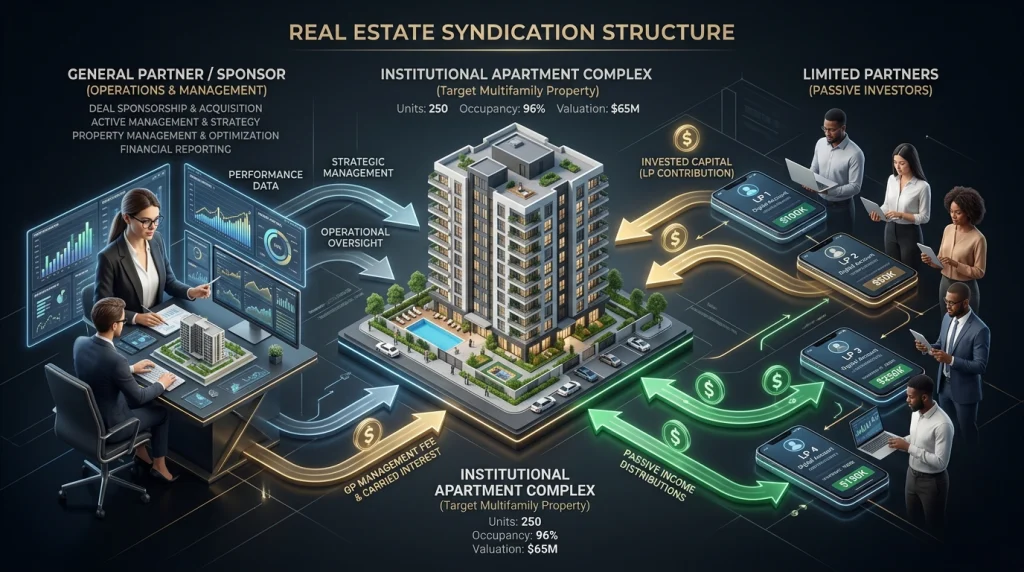
Real estate syndications operate under a legal structure divided into two distinct groups of participants: General Partners and Limited Partners.
- General Partners (GPs) or Sponsors: The active operators who find the deal, perform market analysis, secure financing, execute the business plan, oversee property management, and manage the asset through to disposition. They take on active liability and operational responsibility.
- Limited Partners (LPs) or Passive Investors: The capital providers who invest money into the deal. LPs hold fractional ownership in the entity (usually an LLC or LP), have limited liability strictly tied to their capital contribution, and receive passive income distributions without taking part in day-to-day decisions.
Key Benefits of Real Estate Syndications
Investing as a Limited Partner offers several unique advantages for high-earning professionals and passive income seekers looking to optimize their portfolio efficiency:
1. Access to Commercial Scale Assets: Instead of purchasing a single-family rental or small duplex, syndication investors buy equity in 200-unit apartment communities, modern distribution centers, or class-A medical office buildings. These larger assets benefit from economies of scale, professional on-site management, and lower overall vacancy risk.
2. Complete Passivity: Syndications are 100% passive. Once you complete your due diligence on the sponsor and sign the subscription documents, your active work is complete. Cash distributions are wired directly to your bank account monthly or quarterly.
3. Institutional Tax Efficiency: Passive investors receive all the tax benefits of direct ownership, passed through via an annual Schedule K-1. Sponsors routinely utilize advanced tax strategies—such as cost segregation studies and accelerated depreciation—which often allow passive investors to report paper losses that offset their passive cash flow distributions for tax purposes.
Risks and Key Considerations
While syndications deliver unmatched convenience, they carry specific structural trade-offs that every investor must evaluate prior to committing capital:
- Capital Illiquidity: Syndications are medium- to long-term commitments. Capital is typically locked up for holding periods ranging from 3 to 7 years while the sponsor executes their value-add business plan. There is no active public market to sell your shares early.
- Lack of Operational Control: As an LP, you delegate all operational authority to the sponsor. If market conditions shift or execution falters, you cannot step in to take over management of the asset.
- Accreditation Requirements: Most private equity deals operate under SEC Regulation D (506(b) or 506(c)) exemptions, which frequently restrict investment opportunities to accredited investors (defined generally as an individual net worth exceeding $1M excluding primary residence, or annual income exceeding $200k/$300k jointly for the past two years).
- Waterfall Distributions and Fee Structures: Understand how profits are split. A common deal structure includes a preferred return (e.g., 7% to 8% paid to LPs before the GP receives performance distributions), followed by a split (e.g., 80/20 or 70/30) between LPs and GPs once preferred hurdles are met.
Direct Ownership vs. Real Estate Syndications
To determine if private equity placement fits your passive income strategy, consider how it compares to direct real estate ownership:
| Feature | Direct/Turnkey Ownership | Real Estate Syndication (LP) |
|---|---|---|
| Active Involvement | Low to Moderate (decision-maker) | Zero (100% passive) |
| Minimum Investment | $20,000 – $50,000 (down payment) | $25,000 – $100,000+ per deal |
| Property Type | Residential (1-4 units) | Commercial / Institutional (Multifamily, Industrial, Storage) |
| Liquidity | Moderate (3-6 months to list and sell) | Illiquid (Locked for 3-7 year hold period) |
| Tax Reporting | Standard Schedule E | Schedule K-1 (Pass-through depreciation) |
For investors prioritizing time freedom and tax-advantaged yield over operational control, private real estate syndications offer a high-yield, streamlined approach to expanding your wealth engine. Success in this asset class boils down to one critical step: vetting the sponsor. When you align with an experienced, conservative operator with a proven track record across economic cycles, real estate syndications become one of the most reliable sources of hands-off passive income available today.
Tax Strategies and Scaling Your Real Estate Portfolio
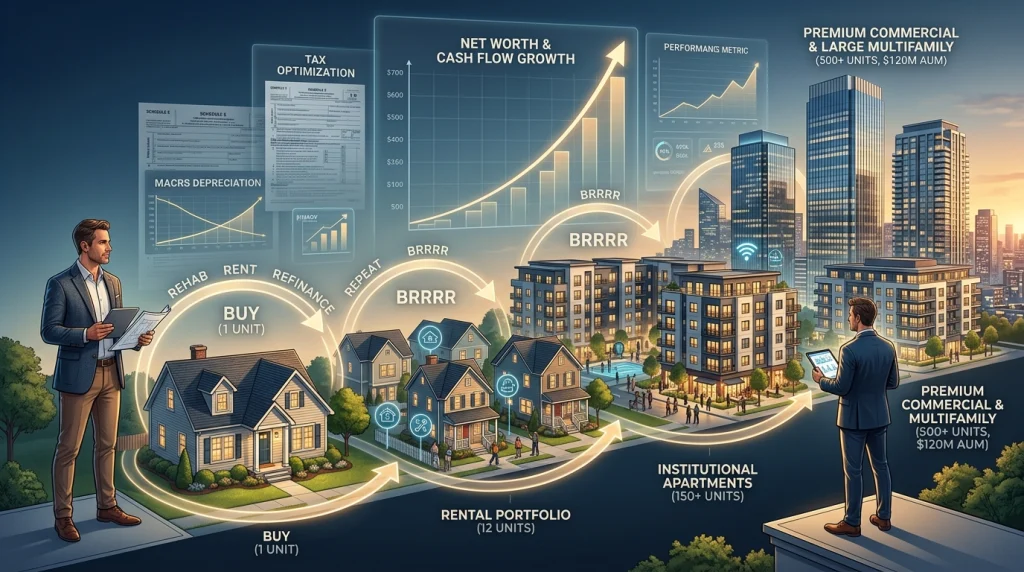
Generating cash flow is only half the equation when mastering how to build passive income with real estate in 2026. The true power of real estate lies in wealth retention and compound growth. By combining IRS-sanctioned tax incentives with systematic reinvestment strategies, sophisticated investors can legally shelter their rental income, recycle their initial capital, and scale from a single property to a multi-million-dollar portfolio without constantly pulling from personal savings.
1. Maximizing Wealth Retention Through Advanced Tax Strategies
Real estate remains one of the most tax-favored asset classes in the global economy. To maximize your net returns, you must move beyond basic expense deductions and leverage high-level tax frameworks that turn paper losses into real-world returns.
- Accelerated Depreciation and Cost Segregation: While standard residential properties depreciate over 27.5 years (and commercial over 39 years), a Cost Segregation Study uses engineering principles to break down a building into its core components. Items like carpet, landscaping, specialized lighting, and paving can be depreciated over 5-, 7-, or 15-year schedules. In 2026, combining cost segregation with available bonus depreciation rules allows investors to front-load tax deductions into year one, offsetting substantial rental revenues.
- The 1031 Tax-Deferred Exchange: Governed by Section 1031 of the Internal Revenue Code, this mechanism allows you to sell an appreciated property and reinvest 100% of the proceeds into a “like-kind” property while deferring all capital gains taxes and depreciation recapture. To successfully execute a 1031 exchange:
- Use a Qualified Intermediary (QI) to handle funds prior to closing.
- Identify potential replacement properties within 45 calendar days of closing the sale.
- Acquire the new property within 180 calendar days.
- Real Estate Professional Status (REPS): For investors looking to optimize tax efficiency across their entire household income, acquiring REPS status is a game-changer. If you or your spouse spend at least 750 hours per year—and more than half of your professional working time—materially participating in real estate trades or businesses, the IRS removes passive loss limitations. This allows real estate paper losses (via depreciation) to offset active w-2 or business income.
| Tax Strategy | Primary Mechanism | Key Benefit for Investors |
|---|---|---|
| Cost Segregation | Reclassifies building assets into shorter recovery periods. | Creates large upfront tax deductions to shelter cash flow. |
| 1031 Exchange | Defers capital gains and tax recapture into a new property. | Allows 100% of equity to compound into larger assets. |
| REPS (IRS Sec 469) | Treats real estate losses as non-passive for qualified owners. | Shelters ordinary W-2/business income using real estate paper losses. |
2. Strategic Frameworks for Scaling Your Passive Engine
Scaling a portfolio does not mean multiplying your workload. As your holdings grow, your operational strategy must shift from direct management to system design and equity recycling.
Recycling Capital via the BRRRR Method
The BRRRR framework (Buy, Rehab, Rent, Refinance, Repeat) remains the gold standard for rapid expansion without continuous out-of-pocket capital injections. In today’s market environment, executing BRRRR requires conservative underwriting:
- Buy: Purchase an undervalued property requiring physical or operational improvements at a steep discount.
- Rehab: Execute forced appreciation by adding bedrooms, upgrading kitchens, or modernizing systems to boost both value and rental rate.
- Rent: Lease the property to high-quality tenants to establish predictable operational cash flow.
- Refinance: Perform a rate-and-term or cash-out refinance based on the newly appraised After-Repair Value (ARV). Aim to pull out 100% of your initial capital while keeping the post-refinance Debt Service Coverage Ratio (DSCR) safely above 1.25x.
- Repeat: Deploy the tax-free refinanced capital directly into your next acquisition.
Harvesting Equity Without Selling
If you hold long-term properties with substantial built-up equity, you don’t need to sell to fund growth. Executing a cash-out refinance or securing a commercial Home Equity Line of Credit (HELOC) allows you to extract liquidity tax-free (since debt is not taxed as income). You can then use those funds as down payments on larger income-producing assets, effectively using your existing portfolio to seed your next phase of growth.
3. Transitioning to 100% Hands-Off Operations
True passive income requires separating your time from your real estate revenue. As your portfolio expands, build an operational system that runs seamlessly without your daily intervention:
- Institutional Property Management: Transition management away from DIY approaches once you reach 3–5 units. Allocate 8% to 10% of gross revenues to professional property managers who handle tenant screening, maintenance calls, rent collections, and legal compliance.
- Automated Stack & PropTech Integration: Leverage modern software platforms (such as AppFolio, Buildium, or RentRedi) for financial tracking, lease renewals, and maintenance portal routing. Automation provides real-time oversight of key operational metrics—such as net operating income (NOI), occupancy rate, and cash-on-cash return—from a single dashboard.
- Standardized Vendor Networks: Establish preferred relationships with trusted contractors, handymen, HVAC specialists, and legal advisors. Having an on-call team minimizes downtime during tenant turnovers and protects your asset values.
By coupling aggressive tax-deferral strategies with disciplined equity recycling and automated management systems, you build a self-sustaining real estate engine. This approach protects your cash flow from income taxes while compounding your passive income stream year after year.
Frequently Asked Questions About Building Passive Income with Real Estate in 2026
How much capital do I need to start building passive income through real estate in 2026?
The upfront capital required depends entirely on your chosen investment vehicle. For direct residential property acquisitions, conventional lenders typically require a 20% to 25% down payment for investment properties, meaning a $300,000 home requires $60,000 to $75,000 plus closing costs. However, lower-barrier strategies exist: house hacking allows you to buy up to a 4-unit property with as little as 3.5% down using FHA loans, while fractional ownership, real estate crowdfunding platforms, and Real Estate Investment Trusts (REITs) enable you to generate passive income with initial capital ranging from $500 to $5,000.
Is real estate passive income truly hands-off, or does it require active management?
Direct real estate ownership is rarely 100% passive at the start. Asset selection, due diligence, financing, and initial setup demand active effort. However, you can convert direct holdings into a largely hands-off income stream by hiring a vetted, third-party property management company—typically for 8% to 12% of gross monthly rent—and integrating automated property management software. For investors seeking complete passivity from day one, syndicated real estate deals, private equity funds, and public REITs require zero operational oversight.
What is the best real estate passive income strategy for beginners in 2026?
For capital-constrained beginners, house hacking remains the top strategy in 2026 because it combines low down-payment primary mortgage financing with immediate rental income from adjacent units or bedrooms. For beginners with available investment capital who want minimal operational friction, turnkey rental properties—renovated assets with vetted tenants and professional management already in place—provide immediate, predictable cash flow without the steep learning curve of property rehabilitation.
How do current interest rates impact real estate cash flow, and how should investors adjust?
Elevated interest rates increase monthly debt service, tightening net cash-on-cash returns for traditional long-term rentals. To maintain strong returns in 2026, successful investors adapt by targeting value-add properties (forcing appreciation and higher rents through targeted capital expenditures), leveraging creative financing like seller financing or loan assumptions, acquiring multi-family properties for economies of scale, and structuring larger initial equity contributions to keep monthly mortgage obligations manageable.
How can I shelter my real estate passive income from taxes?
Real estate benefits from tax efficiency unmatched by most asset classes. You can offset your rental income using non-cash depreciation deductions, often reporting a tax loss on paper while generating positive net cash flow. Advanced strategies include using cost segregation studies to accelerate depreciation in early years, deducting all operational expenses and debt interest, and using 1031 exchanges to defer capital gains and depreciation recapture taxes indefinitely when compounding equity into larger assets.
Final Verdict: Building Modern Real Estate Wealth
Mastering how to build passive income with real estate in 2026 requires a modern approach that balances fundamental cash flow analysis with innovative financing, tech-driven property management, and strategic tax planning. While market dynamics continuously evolve, real estate remains one of the most reliable vehicles for long-term wealth creation and financial autonomy. Success in today’s economic landscape does not come from passive hoping; it demands calculated property selection, disciplined risk management, and leveraging scale through multi-family assets, REITs, or short-term rentals.
The path to building sustainable passive income begins with taking decisive action. Start by auditing your current financial profile, establishing clear investment criteria for your target markets, and choosing the strategy that best aligns with your capital and risk tolerance. The market in 2026 rewards those who combine deep market research with immediate execution.