Nothing Phone 4a vs Pixel 10a: Which Mid-Range Phone Wins in 2026?
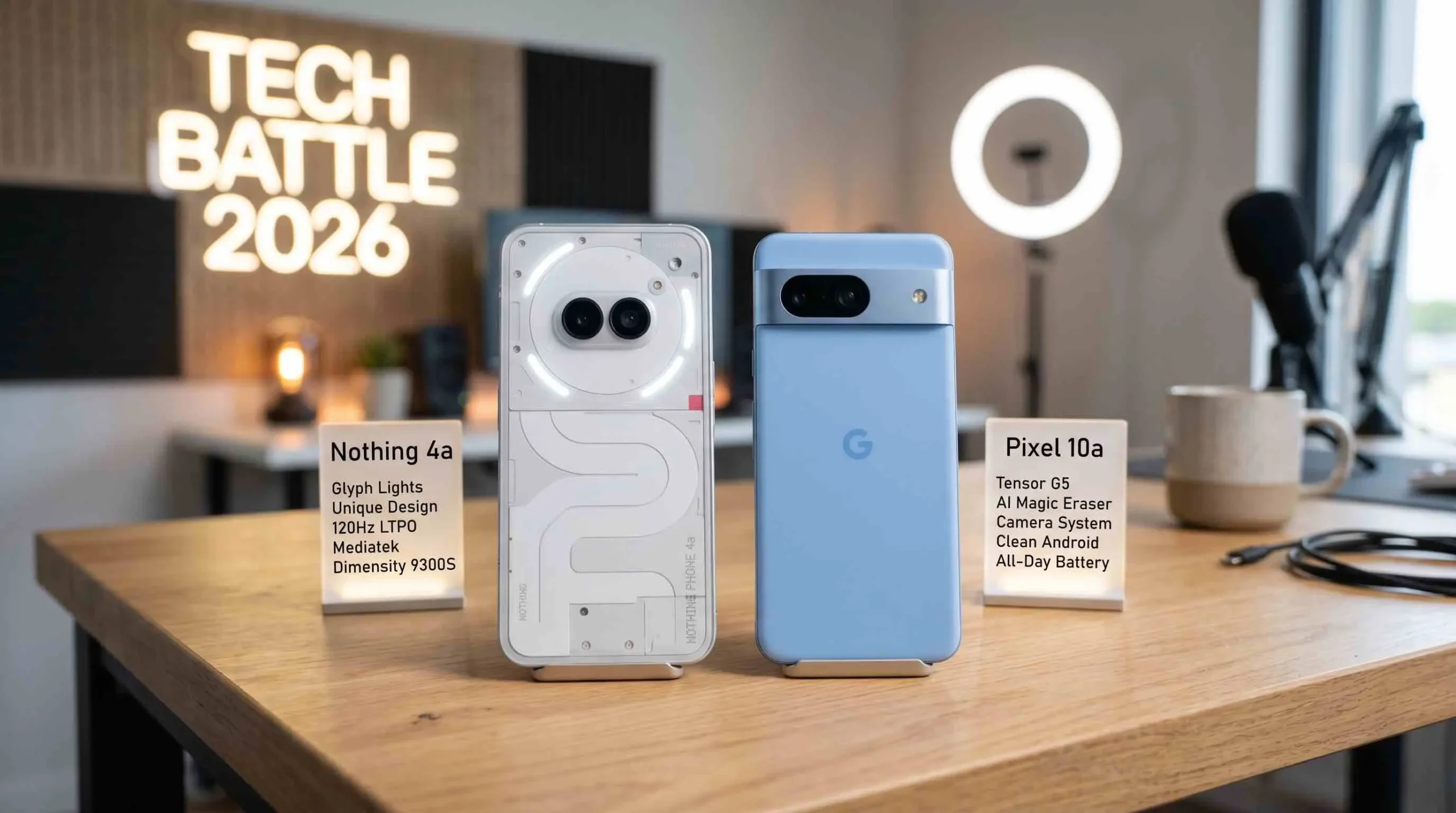
The mid-range phone market gets interesting on March 5, 2026, with two strong contenders arriving at the same time. Choosing between the Nothing Phone 4a vs Pixel 10a comes down to priorities: bold design and hardware flair or reliable software and AI-driven features.
Prefer a standout look or a phone that quietly nails everyday tasks? This comparison breaks down performance, camera quality, battery life, and real-world value so you can pick the right phone for your needs.
Quick verdict: If you prioritize striking design and hardware features (like manual zoom control), the Nothing Phone 4a is the choice; if you want consistent AI image processing, longer software support, and a clean Google experience, pick the Pixel 10a. Read on for the full breakdown and our recommendations.
Table of Contents
Key Takeaways
- Both phones launch in early March 2026, creating a direct mid-range rivalry.
- The Nothing Phone 4a emphasizes design and unique hardware touches; the Pixel 10a focuses on software and AI-driven image processing.
- Real-world performance depends on chipset choice and thermal design more than headline specs.
- Battery and charging behavior differ in daily use—check wired vs wireless preferences before buying.
- Our guide turns technical specs into clear advice so you can choose the phone that fits your lifestyle.
Design Philosophy and Build Quality
Design and build are where these mid-range phones first make an impression. Weight, texture, and materials shape daily handling — and Nothing and Google take clearly different routes.
Nothing Phone 4a: The Glyph Interface Evolution
The Nothing Phone 4a doubles down on industrial aesthetics, showcasing a semi-transparent back that exposes parts of its internal layout for a futuristic look. The Glyph interface has been refined, offering more control over light patterns for notifications and visual feedback.
This model stands out with a transparent glass back (verify exact glass type). It reads as premium and hi‑tech while keeping an ergonomic shape that fits the hand.
- Pros: Bold, distinctive look; unique notification glyphs.
- Cons: More attention‑grabbing — may not suit users who prefer understated designs.
Pixel 10a: Refined Material Design and Sustainability
The Pixel 10a favors a minimalist approach built for everyday durability. Google pairs a high‑quality composite rear with an aluminum frame for a solid, balanced feel.
Sustainability plays a role: recycled materials are used without sacrificing strength, and the Pixel 10a’s matte finishes (four color options) give a subdued, premium look.
- Pros: Practical, comfortable grip; understated styling; likely better drop resilience with aluminum frame.
- Cons: Less visually distinctive than Nothing’s transparent design.
| FeatureNothing Phone 4aPixel 10a | ||
| Primary Material | Transparent Glass/Metal | Composite/Aluminum |
| Design Focus | Industrial/Glyph Lighting | Minimalist/Ergonomic |
| Color Options | Signature Monochrome | Four Matte Finishes |
| Durability Feel | Premium/Refined | Rugged/Solid |
Design pros/cons: If you drop phones frequently, favor the Pixel 10a’s aluminum frame and verified Gorilla Glass protection (confirm exact Corning Gorilla Glass version). If you want a standout design and tactile novelty, the Nothing Phone 4a delivers with its glyph matrix and transparent look.
See the display and camera sections for how each phone’s design affects handling, image capture, and thermal behavior.
Display Technology and Visual Experience
The display is your window to content, and these two phones prioritize different strengths. The Nothing Phone 4a favors size and fluidity, while the Pixel 10a focuses on brightness and natural color reproduction. Which matters most depends on how you use your phone.
Do you value raw smoothness for gaming and scrolling, or do you want accurate colors and better visibility in sunlight for reading and photography?
Refresh Rates and Peak Brightness Comparison
The Nothing Phone 4a uses a 6.83-inch AMOLED panel with a 144 Hz refresh rate. That high refresh rate delivers extra-smooth animations and makes fast-paced games feel more responsive — you can notice the difference in shooters and competitive titles.
The Pixel 10a ships with a 6.29-inch Actua display running at a 120 Hz refresh rate. Google tunes the display for consistent performance and excellent outdoor legibility — a big help when you read or browse in bright sunlight.
Color Accuracy and Outdoor Visibility
In general, the Pixel 10a prioritizes natural, accurate colors and higher peak brightness (confirm exact nits), which improves readability outdoors and yields truer image tones for photos. The Nothing Phone 4a leans into deeper contrast and punchier saturation, which makes video and games pop.
Keep in mind that a higher refresh rate (144 Hz) can use more power than 120 Hz — so the Nothing’s smoother screen may affect battery life more during heavy use. If battery endurance outdoors is a priority, Pixel’s brighter panel can be more practical.
Quick display summary:
- Best for gaming and smooth motion: Nothing Phone 4a (144 Hz, larger 6.83″ screen).
- Best for outdoor visibility and color accuracy: Pixel 10a (120 Hz Actua display, higher peak brightness).
Here’s a quick comparison table of the core screen specs to help you decide.
| FeatureNothing Phone 4aPixel 10a | ||
| Display Size | 6.83 inches | 6.29 inches |
| Refresh Rate | 144 Hz | 120 Hz |
| Panel Type | AMOLED | Actua OLED |
| Primary Strength | Fluidity | Outdoor Brightness |
Performance and Hardware Specifications
Under the hood, the Nothing Phone 4a and Pixel 10a take different routes: one prioritizes raw gaming smoothness and thermal control, the other emphasizes AI processing and photo workflows. These specification choices determine everyday responsiveness for apps, multitasking, and background work.
Processor Efficiency and Thermal Management
The Nothing Phone 4a runs on the Snapdragon 7 Gen 4, a mid‑range Snapdragon that leans toward sustained GPU performance and efficient thermals. That makes it well suited for longer gaming sessions and steady frame rates under load — especially paired with the 144 Hz display.
Google’s Pixel 10a uses the Google Tensor G4, which is tuned more for on‑device AI-driven tasks like photo processing, speech recognition, and background optimizations. The Tensor G4 emphasizes machine learning acceleration over raw GPU peak performance.
- Snapdragon 7 Gen 4 (Nothing): Strong sustained gaming performance; favors active cooling strategies to manage heat.
- Tensor G4 (Pixel): excels at computational photography and AI features; optimized for smooth multitasking and background inference.
RAM and Storage Configurations for 2026 Standards
Both phones start with a sensible base of 128GB storage. RAM tiers and higher storage SKUs vary by market — check for 8GB vs 12GB options depending on your region and carrier. If you store lots of photos or edit video on-device, opt for the larger storage tier.
Real-world performance depends on the whole package: processor, RAM, storage speed, and thermal design. For example, the Nothing Phone 4a’s active cooling and higher refresh display favor gaming and long sessions; the Pixel 10a’s AI pipeline makes it feel faster when processing photos and using assistant features.
| FeatureNothing Phone 4aPixel 10a | ||
| Processor | Snapdragon 7 Gen 4 | Google Tensor G4 |
| Base Storage | 128GB | 128GB |
| Primary Focus | Gaming Efficiency | AI Processing |
| Thermal Design | Active Cooling | Passive AI Optimization |
Real-world recommendations: If you play competitive games or prioritize the smoothest frame rates and responsive touch, lean toward the Nothing Phone 4a with a higher RAM/storage SKU. If you rely on on‑device AI features, frequent photo editing, or want consistent background efficiency, the Pixel 10a’s Tensor G4 is the better match.
Camera Quality and Computational Photography
Mobile photography blends hardware and software. In this mid-range matchup, Nothing leans on optical hardware while Google leans on computational processing to produce great results without demanding manual work.
Nothing Phone 4a: Sensor Capabilities and Night Mode
The Nothing Phone 4a focuses on tangible camera hardware. It reportedly includes a high-resolution primary main camera sensor and, unusually for this tier, a periscope zoom lens that enables longer-range shots with less quality loss than typical digital zoom.
Night shots benefit from a dedicated Night Mode that brightens shadows and reduces grain while keeping colors believable. Key strengths:
- High-resolution main sensor: sharp daytime detail and wide dynamic range (verify exact sensor model).
- Periscope telephoto lens: better long-range framing and subject isolation without heavy cropping.
- Night Mode improvements: cleaner low-light photos with reduced noise.
Best for: travel and event shooters who want optical zoom and flexible framing without carrying extra gear.
Pixel 10a: Google’s AI-Driven Image Processing
The Pixel 10a leans on Google’s computational photography strengths. Instead of pushing high zoom optics, it applies algorithms to boost detail, dynamic range, and color rendering so images look great straight out of the camera app.
Google’s software handles tricky scenes automatically — portraits, moving subjects, and mixed lighting — giving consistent results across situations. Notable points:
- Smart processing: AI-driven enhancements for skin tones, HDR stacking, and motion handling (confirm available features like Magic Editor or Motion Mode on the 10a).
- Reliable low-light shots: computational stacking and noise reduction produce balanced images even indoors.
- Video usability: stabilized clips and accurate color for social sharing (verify max video resolution and frame rates).
Best for: users who want effortless, consistently pleasing photos and quick image edits powered by on‑device AI.
Photo checklist — try these to compare:
- Daytime landscape (detail + dynamic range)
- Portrait with background blur (subject separation and skin tones)
- Low-light indoor (noise and color)
- Zoom shot at distance (optical vs digital performance)
Which should you choose? If optical zoom and manual framing matter most — especially for travel or events — the Nothing Phone 4a’s periscope lens is compelling. If you prefer a camera that consistently produces great images with minimal effort, the Pixel 10a’s computational image processing is the safer pick.
For a deeper camera shootout, compare full-size sample photos and EXIF data where available—that will reveal real-world differences in sensor performance and processing.
Software Ecosystem and User Interface
Software shapes daily experience as much as hardware. Both phones run Android, but their UIs target different users: Nothing OS for people who like to personalize, and Pixel UI for those who want a fast, familiar Google experience.
Nothing OS: Customization and Minimalist Aesthetic
Nothing OS offers a distinctive, minimalist aesthetic — think dot‑matrix accents, monochrome icons, and carefully curated widgets. The interface is designed to look clean and purposeful while letting users make it their own.
Customization is deeper than skins: you can resize Quick Settings tiles, tweak the lock screen layout, and rearrange interface elements to prioritize the apps and shortcuts you use most. For people who enjoy tweaking appearance and behavior, Nothing OS rewards that effort.
Example workflow: set a compact lock screen with only media and commute shortcuts for a distraction‑free morning routine.
Pixel UI: The Pure Android Experience and Feature Drops
The Pixel 10a delivers a pure Android experience tuned by Google. The interface is simple, responsive, and immediately familiar — useful if you want a phone that “just works” out of the box without much setup.
One of Pixel’s biggest advantages is regular feature drops and timely updates. These add AI tools and camera improvements over time (for example, smarter photo editing or updated assistant features), so the phone can gain capabilities after purchase.
Example workflow: rely on Pixel UI’s automatic organization and AI routines to surface calendar events, quick replies, and camera enhancements without manual setup.
Updates & security: Both platforms promise ongoing support; check the Connectivity section for official OS and security update timelines before deciding if long‑term updates are a priority.
Who should pick which? If you love personalization and a unique aesthetic, go Nothing Phone. If you want a streamlined, constantly evolving Google Pixel experience with frequent feature drops, choose the Pixel 10a.
Battery Life and Charging Capabilities
Battery life is a daily concern — whether you’re commuting, gaming, or streaming video. Below we compare real-world endurance and charging trade-offs so you know which phone fits your routine.
Endurance Testing in Real-World Scenarios
The Nothing Phone 4a ships with approximately 5080mAh of battery capacity, while the Pixel 10a offers around 5100mAh. Both capacities are generous for the mid-range class and translate to a full day of mixed use for most people.
In practice: the Pixel 10a often wins on standby and light‑use longevity thanks to Google’s software optimizations; the Nothing Phone 4a can edge ahead during active, screen‑on sessions (gaming, extended browsing) because its power management pairs tightly with its display and thermal profile.
Real-world test examples:
- Video streaming: expect full-day playback figures on both phones; minor differences depend on brightness and refresh rate settings.
- Gaming: the Nothing Phone 4a’s active cooling and efficient chipset help maintain performance, but higher refresh use will drain battery faster.
- Standby: Pixel 10a’s background optimizations often yield slightly longer idle endurance.
Wired vs Wireless Charging Speeds
Charging behavior matters as much as capacity. The Nothing Phone 4a emphasizes fast wired charging — useful when you need a quick top‑up before heading out. The Pixel 10a supports fast wired charging too and typically includes more convenient wireless charging options for overnight or desk‑top top‑ups.
Exact charging wattages and 0→50% minutes should be checked against manufacturer specs and independent tests, but the practical takeaway is simple:
- If you need fast daily top‑ups: prefer the Nothing Phone 4a’s rapid wired charging performance.
- If you prefer convenience and occasional cordless charging: the Pixel 10a’s wireless charging support is a stronger match.
| FeatureNothing Phone 4aPixel 10a | ||
| Battery Capacity | 5080mAh | 5100mAh |
| Wired Charging | High‑speed rapid (check exact W) | Fast (check exact W) |
| Wireless Charging | Supported | Supported (convenient option) |
| Typical Endurance | Full Day+ | Full Day+ |
Before you buy: confirm the bundled charger (some retailers omit chargers), check the exact wired wattage and wireless standard, and look up independent “minutes to 50%” charging tests for each phone to match your charging habits (commuter vs traveler).
Connectivity and Future-Proofing
When you buy a mid-range phone, think beyond today’s specs — prioritize networks, updates, and features that keep the device useful for years. Future-proofing reduces the chance you’ll be shopping again in 18 months.
5G Performance and Wi-Fi 7 Integration
Both the Nothing Phone 4a and the Pixel 10a include modern 5G modems to handle fast mobile data, low-latency cloud gaming, and reliable video calls. Check carrier band compatibility for your region, since real-world 5G performance varies by country and carrier.
These models also reference advanced Wi‑Fi standards — manufacturers are preparing for faster home and office networks. Confirm whether your carrier and router ecosystem support the advertised Wi‑Fi capability (Wi‑Fi 7 is still rolling out), because that determines the real benefit you’ll get.
“Technology is best when it brings people together and stays relevant as the world evolves around us.”
Software Support Longevity and Security Updates
Software updates and security patches matter as much as hardware. Verified update policies are a major factor in long‑term value: they affect feature availability, security, and resale value.
Nothing currently promises a defined OS and security timeline (for example, around three major OS updates and multiple years of security patches — confirm exact terms). Google traditionally offers longer, clearly defined support for Pixel devices; check the Pixel 10a’s official update window for exact years and cadence.
| FeatureNothing Phone 4aPixel 10a | ||
| 5G Connectivity | Advanced Modem | Advanced Modem |
| Wi-Fi Standard | Wi‑Fi 7 (verify) | Wi‑Fi 7 (verify) |
| Security Updates | 6 Years (verify exact terms) | Extended Support (check official years) |
Which matters more? If you plan to keep a phone for multiple years, prioritize verified update guarantees and strong security support over raw specs. If you move between networks or travel internationally, prioritize wide 5G band support and check local carrier compatibility.
Finally, don’t forget water resistance and sensor quality when future-proofing: IP ratings and robust sensors (for biometrics and environmental sensing) extend everyday reliability. If you rely on long-term security and frequent software enhancements, the Pixel 10a’s update track record is a strong selling point; if you value emerging connectivity standards and a unique feature set, the Nothing Phone 4a is competitive — just confirm all advertised Wi‑Fi and update claims before buying.
Price Point and Value Proposition
The upfront price is only part of the story. Both the Nothing Phone 4a and the Pixel 10a launch at roughly $499 in the US, but total cost of ownership depends on software support, resale value, and ongoing accessories or service fees.

Analyzing the Cost of Ownership
When evaluating value, include software updates, potential resale, and accessories. For example, a basic three‑year ownership model looks like this:
- Initial cost: $499 (MSRP, US) — verify regional pricing and carrier deals.
- Accessories & protection: add $30–$150 for cases, screen protectors, and chargers if not bundled.
- Depreciation / resale: subtract expected resale (Pixel historically holds value well; niche brands like Nothing can also retain value in enthusiast markets).
The Nothing Phone 4a leans into design and hardware uniqueness, which appeals to collectors and creative users. The Pixel 10a prioritizes long‑term software polish and AI features that add practical value over time.
“Value is not merely the lowest price you pay, but the total benefit you receive over the entire lifespan of your technology.”
— Tech Industry Analyst
Resale Value and Market Positioning
Resale depends on brand reputation, update policies, and demand. Historically, Google Pixel phones enjoy solid resale (low depreciation) because of consistent software support and broad market awareness. Nothing phones can command higher resale in niche circles thanks to distinctive design and limited availability, but that can vary by region.
| FeatureNothing Phone 4aPixel 10a | ||
| Starting Price | $499 (US MSRP) | $499 (US MSRP) |
| Software Support | 3 Years (confirm exact policy) | 5 Years (confirm exact policy) |
| Market Demand | High (Niche / Enthusiast) | High (Mass / Mainstream) |
| Depreciation Rate | Moderate (varies) | Low (tends to hold value) |
Want a concrete comparison? If you plan to keep a phone three years, estimate resale and subtract it from MSRP, then add likely accessory costs. For budget‑minded buyers, also check:
- Carrier trade‑in offers and financing — can lower effective price
- Bundle discounts (cases, chargers, earbuds)
- Extended warranty or insurance costs
Comparing the Nothing Phone 4a vs Pixel 10a on price comes down to priorities: pick the Pixel if update longevity and steady resale matter most; pick the Nothing Phone if design, unique features, and the potential for niche resale value excite you. Also compare Samsung Galaxy trade‑in and pricing deals when shopping — sometimes promotions shift the best value decision.
Nothing Phone 4a vs Pixel 10a: The Verdict on Mid-Range Supremacy
There’s no single winner — the right pick depends on what you value most. This comparison highlights the trade-offs so you can match a phone to your priorities: design and hardware flair, or AI-driven software and steady updates.
Identifying Your Ideal User Profile
If you love bold, statement design and tactile hardware features, the nothing phone is built for you — it stands out in hand and rewards creative users who enjoy manual control and distinctive accents like the glyph matrix.
If you prefer a phone that focuses on consistent camera results, smart AI features, and long‑term software polish, the pixel experience on the Google Pixel 10a is a better match — especially for users who put a premium on updates and reliable computational photography.
Final Recommendations Based on Priorities
Use this quick guide to decide which phone aligns with your needs:
| CategoryNothing Phone 4aPixel 10a | ||
| Primary Strength | Design & Hardware | AI & Software |
| Best For | Creative Enthusiasts | Power Users |
| Camera Focus | Manual Control & optical zoom | Computational AI & consistent processing |
| Value Metric | Build & design appeal | Update longevity & reliability |
Quick pick: Pick the Nothing Phone 4a if you want a design-forward, conversation-starting device with strong hardware features; pick the Google Pixel 10a if you want a dependable, software-first phone with excellent computational camera and longer-term support.
Scenario examples:
- Commuter: Pixel 10a — reliable battery management, bright display for outdoor reading, and helpful AI features on the go.
- Photographer/traveler: Nothing Phone 4a — optical periscope zoom and punchy display for framing distant shots (verify lens specs).
- Mobile gamer: Nothing Phone 4a — higher refresh display and active cooling favor longer gaming sessions.
Ultimately, the Nothing Phone 4a and the Pixel 10a both deliver strong mid-range value; your day‑to‑day priorities — whether design, camera style, display, or update longevity — should guide the final choice. Compare deals, check carrier promotions, and view camera samples to make the most informed decision.
Conclusion
Choosing a new phone in 2026 comes down to how you use it every day. This review shows the Nothing Phone 4a and the Pixel 10a take different approaches: Nothing prioritizes bold design and tactile hardware, while Google prioritizes seamless software, AI features, and long-term polish.
The Nothing Phone 4a is ideal for style‑minded users who want a conversation piece with capable hardware and distinctive touches. The Pixel 10a (Google Pixel 10a) is best for people who want dependable performance, timely updates, and excellent computational camera results.
Quick final pick: Choose the Nothing Phone 4a for standout design and hardware flair; choose the Google Pixel 10a for software, consistent imaging, and longer update support.
If you still can’t decide, test both in‑store if possible, compare full‑size camera samples online, and check current carrier or Samsung Galaxy trade‑in deals — those promotions often shift the best value. Consider your daily priorities (display, camera, battery, or update longevity) and pick the phone that matches them.
FAQ
Nothing Phone 4a vs Pixel 10a — which has the better camera quality?
It depends on what you value. The Nothing Phone 4a emphasizes hardware — a high‑resolution main camera sensor and (reportedly) a periscope lens that gives superior long‑range zoom shots. The Pixel 10a leans on Google’s computational processing to deliver consistently pleasing images in most situations. For long zooms and manual framing, favor Nothing; for effortless, reliable everyday photos, favor Pixel.
What are the primary differences in specifications between these two phones?
The key differences are in chipset, display, and camera approach. The Nothing Phone 4a uses the Snapdragon 7 Gen 4 and a 144 Hz, larger AMOLED screen optimized for smoothness. The Pixel 10a uses the Google Tensor G4 with a 120 Hz Actua OLED tuned for color accuracy and outdoor brightness. Check the detailed spec sections above for exact numbers and real‑world implications.
Is there a significant price difference between the two phones in 2026?
No — both start near a $499 US MSRP at launch. Actual cost can vary by region, carrier promotions, and trade‑in deals, so compare local pricing and offers before buying.
How does the Snapdragon 7 Gen 4 compare to the Tensor G4 in performance?
Generally, the Snapdragon 7 Gen 4 favors sustained gaming and efficient thermal management, which helps during long sessions at high refresh rates. The Tensor G4 prioritizes on‑device AI acceleration and photo processing, so it may feel faster in tasks like image editing, voice processing, and other ML workloads. Benchmarks and real‑world tests will show the exact gaps for your use cases.
Which phone offers better features for long-term use?
Both aim to be future‑friendly, but software support matters most. Google traditionally provides clearly defined update windows for Pixel devices, which benefits longevity. Nothing also offers multi‑year security support and OS updates (check exact terms for the 4a). If long‑term updates and security are your priority, the Pixel 10a’s track record is a strong factor.
What should I know about battery life and charging?
Both phones offer large batteries that deliver a full day for most users. The Nothing Phone 4a has roughly a 5080mAh cell and emphasizes fast wired charging; the Pixel 10a sits near 5100mAh and supports wireless charging as a convenience. For fast top‑ups, check exact wired wattage and independent “minutes to 50%” tests. Your actual battery life will vary by display refresh, brightness, and usage.
Should I read a review of the Nothing Phone 4a before switching from an iPhone?
Yes. Nothing OS differs from iOS in look and customization: it rewards tweaking and offers a distinct glyph‑driven aesthetic. If you prefer a closer-to-stock, familiar interface, the Pixel 10a may feel more like a straightforward transition. Try both UIs in store if possible or watch hands‑on videos to see which fits your workflow.